Sign: uneven settling
A house settling or sinking on one side
All houses settle a little, evenly, in their first years. Trouble starts when one part goes down more than the rest. The trade calls putting that right house leveling, though the first aim is usually to stop the movement.
How uneven settling shows itself
Stand back and look at lines that should be straight: the eaves, the row of window sills, the mortar joints. A sag toward one corner is easier to spot from across the street than from the driveway.
Up close, the signs gather on the low side. Stepped cracks that widen toward the top. A gap opening under the soffit or where a wall meets the ceiling. Doors on that side all leaning the same way. Floor readings that fall steadily in one direction.
Why one part sinks and the rest does not
Loose sand
Sand that was not compacted well before building keeps packing down under the weight of the house, sometimes for years.
Buried organic material
Old roots, stumps, muck or construction debris under a lot rot away and leave space. The Florida Geological Survey lists these among the ordinary causes of ground settling.
Water moving sand
A leaking pipe, a downspout emptying at the wall or a broken drain can carry sand out from under a footing.
Fill near water
Lots beside lakes, ponds and former wetlands are sometimes built up with fill over soft, wet ground.
Sinkhole activity
Soil ravelling down into a cavity in the limestone. It is one possible cause, and it takes soil testing by a geologist or geotechnical engineer to confirm. See the sinkhole guide.
What house leveling involves
Measure
Floor heights are mapped through the house so the low area and the amount of drop are on paper.
Find firm ground
The company works out, sometimes with soil borings ordered from an engineer, how deep support must go to get below the loose layer.
Support
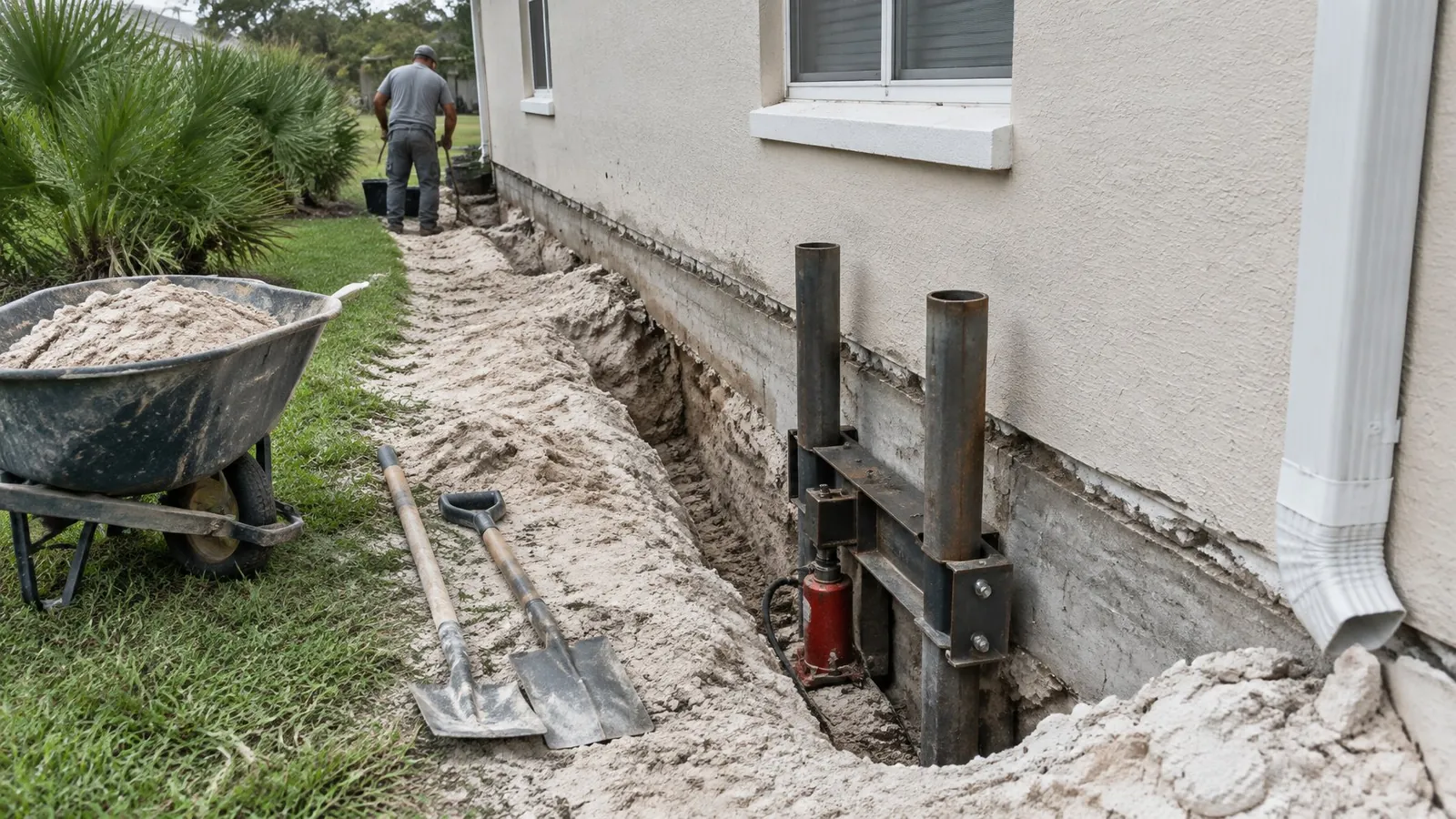
Steel piers are pushed or screwed down beside the footing and bracketed to it. Under some houses the loose soil itself is firmed up by pumping grout into it.
Lift, if it is wise
The house may be raised back toward level on the piers. Lifting can crack finishes and strain pipes, so some repairs stop at holding the house where it is. Ask which is planned and why.
Settling questions
Is my house going into a sinkhole?
It may not be. The Florida Geological Survey points out that settling has many causes besides sinkholes, among them rotting organic material, poorly compacted soil and broken pipes. Only testing of the soil under the house can tell them apart, and that is work for a licensed geologist or geotechnical engineer.
Can a house be lifted all the way back to level?
Sometimes, and sometimes only part of the way. It depends on how far it has dropped, how the house is built and what the lift would do to walls, tile and plumbing. A company should put its lift target in writing and say what happens if the target is not reached.
Ready to have the house looked at?
Only someone standing at the house can tell you what is going on under it. Call, explain what you have noticed, and ask for an inspection.
Describe the problem, book an inspection
Say where the cracks or dips are and when you first saw them. The independent local foundation repair company you reach can set a time to look at the house.
Call (407) 598-8829The call may be recorded. See how referrals are paid for and what happens to your details.