Sign: cracked walls
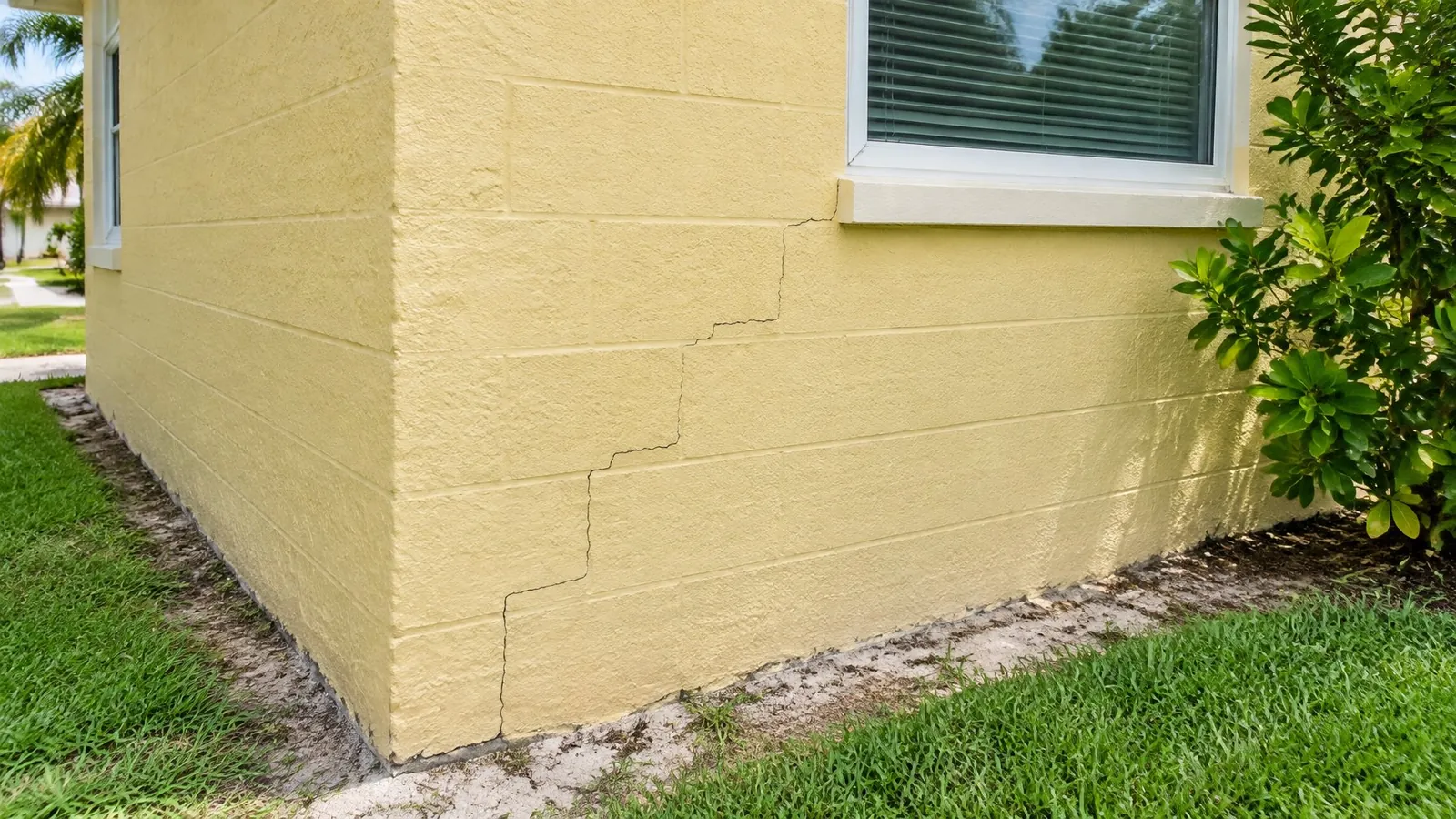
Stair-step cracks in block and stucco walls
Most Orlando houses are concrete block with a coat of stucco. When one part of the footing drops a little, the wall above tends to crack along the mortar joints, up one block and across one block, like a staircase.
Reading the crack
A crack that keeps the same hairline width from end to end, and has looked the same for years, is often only the stucco or the mortar shrinking. Florida sun does that to masonry.
A crack that is wider at one end tells a different story. Wider at the top usually means the wall to one side of it is tipping or dropping. Look for matching signs indoors: a diagonal crack running up from the corner of a window, a gap opening between wall and ceiling, a door on that side that has started to rub.
Cracks in a ceiling alone, with nothing in the walls or floor below, more often come from the roof framing moving with heat and humidity than from the ground.
Crack patterns and their usual causes
| What you see | Often points to | Also caused by |
|---|---|---|
| Stepped crack near a corner of the house, wider at the top | That corner of the footing settling | A downspout or roof valley washing sand out beside the footing |
| Diagonal crack from a window or door corner | The wall on one side moving more than the other | Rust swelling the steel over the opening, which lifts the blocks above it |
| Fine web of cracks across a stucco face | Rarely the foundation | Stucco curing and weathering |
| Straight vertical crack where an addition meets the house | The addition settling on its own footing | No joint left between old and new work |
| Crack along a drywall seam in the ceiling | Rarely the foundation by itself | Roof trusses lifting and easing with the seasons |
These are common patterns, not a finding about your house. Two houses with the same crack can have different causes.
What gets checked at a cracked wall
Width and direction
The crack is measured at several points and the wider end noted. Some companies fix a small gauge across it to see whether it is still moving.
Both faces of the wall
A crack that shows outside and inside at the same place has gone through the block, not only the stucco.
The floor beside it
Floor heights are taken along that wall. A wall crack with a level floor next to it is read differently from one with a dip under it.
Water at the base
Where the roof drains, where sprinklers hit, and whether soil has washed away from the footing.
If it does turn out to be the footing
When the footing under a cracked wall has settled, a company will usually propose holding up that stretch on piers driven or screwed down to firmer ground, then mending the crack and the stucco. If the footing has not moved, the repair is masonry and stucco work, which is a different trade and usually a smaller job. The repair methods guide explains the pier types in plain words.
Two questions about wall cracks
Should I fill the crack with caulk now?
Sealing a crack keeps rain and insects out, and that is reasonable. Take a dated photo with a coin beside it first. A filled crack is much harder for an inspector to read, and a photo record shows whether it has grown.
The crack appeared after a long dry spell. Does that matter?
Mention it when you call. Sandy soil behaves differently dry than wet, and groundwater here is at its low point at the end of the dry season. When a crack showed up is one of the clues an inspector uses.
Ready to have the house looked at?
Only someone standing at the house can tell you what is going on under it. Call, explain what you have noticed, and ask for an inspection.
Describe the problem, book an inspection
Say where the cracks or dips are and when you first saw them. The independent local foundation repair company you reach can set a time to look at the house.
Call (407) 598-8829The call may be recorded. See how referrals are paid for and what happens to your details.