Local ground
Why foundations move in Orlando
Orlando has no bedrock near the surface and almost no frost. What it has is sand, a water table that rises and falls with the seasons, and limestone far below that slowly dissolves. Between them they account for most of the ways a foundation here can move.
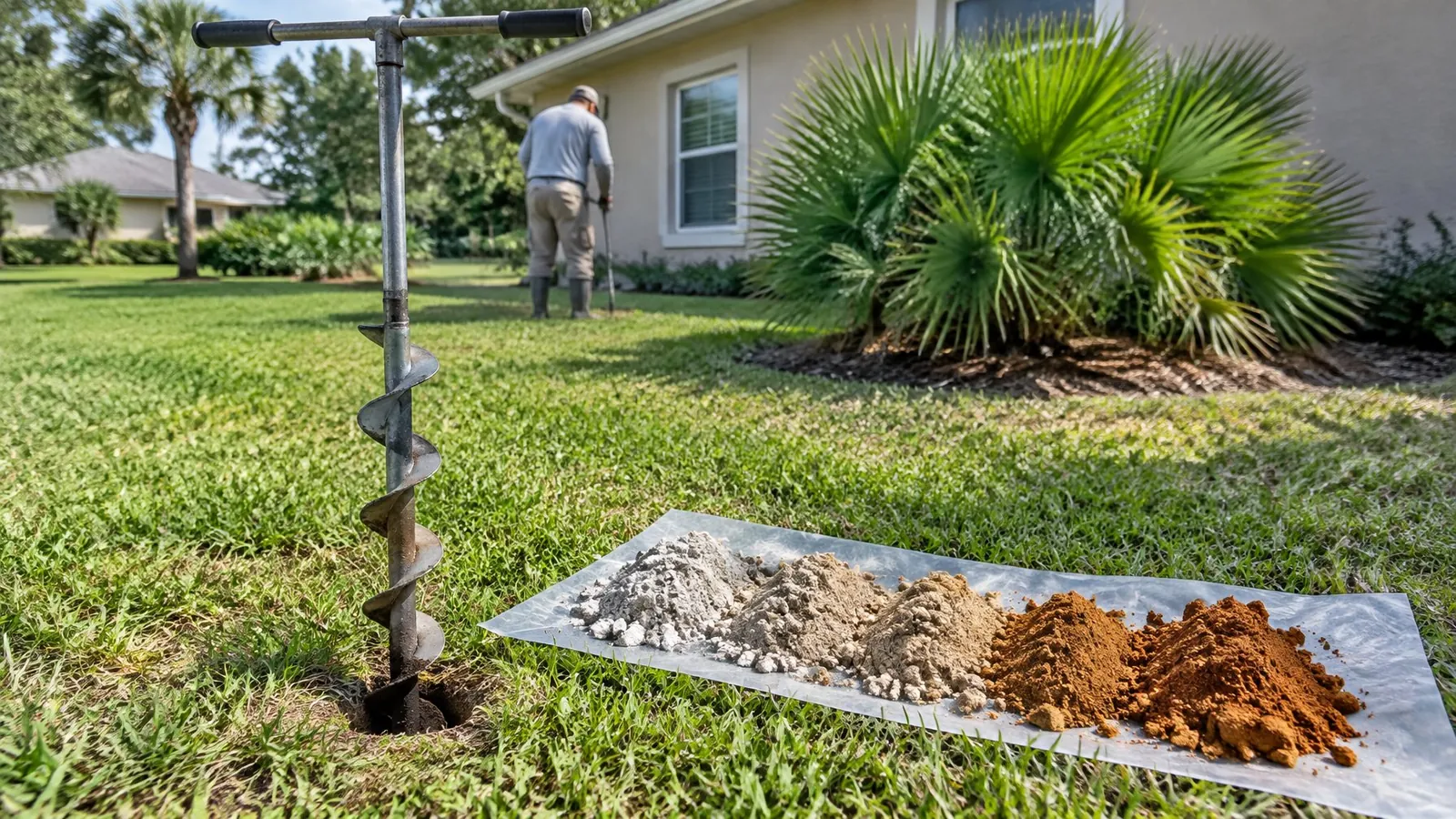
What is under an Orlando house
The U.S. Geological Survey report on Orange County describes the ground here as three layers. On top is loose quartz sand. Below it is a green-gray clay mixed with sand and silt, part of what geologists call the Hawthorn Group. Under that lies limestone, hundreds of feet of it, which holds the Floridan aquifer.
Many Orlando house foundations bear on near-surface soil rather than limestone. How well that sand was compacted, how wet it is and whether anything is carrying it away decide how the house behaves.
Low ground, high ground and lake edges
The city's own conservation study sorts Orlando's soils by where they lie. All of them are sandy. They differ in how wet they stay.
Flatwoods
Much of the Orlando area, the south side in particular, is flat country with poorly drained sand and a water table near the surface. The study notes that some of this low ground has been built on. Sand that is saturated for part of the year gives a footing less support.
Sandy ridges
Higher ground, roughly above 100 feet in elevation, has deep sand that drains well. Rain soaks straight down toward the limestone. The study names these recharge areas as the ones most likely to see the ground subside.
Wetland margins
Around swamps, sloughs and some lake shores the soil is organic muck over sand. Muck compresses and decays, and lots there have often been raised with fill.
Lakes and closed basins
Most natural lakes and ponds in Orange County probably began as sinkholes, the Geological Survey says. That is the long history of the land. It is not a forecast for any one street.
Wet season, dry season
Orlando averages about 50 inches of rain a year, and most of it falls from June through September. The National Weather Service puts the usual start of the wet season in late May and its end in mid-October.
That rhythm reaches a foundation in two ways. In summer, storms drop a lot of water in a short time. Roofs concentrate it, and water landing at the wall can carry sand off. Through the dry months the water table falls. The Geological Survey notes that sinkholes in Orange County frequently occur near the end of the dry season, when groundwater is low, and the Florida Geological Survey has recorded clusters of ground collapses when very heavy rain followed a long drought.
How houses here are built
Most Orlando houses stand on a concrete slab poured on the ground, with concrete block walls above it. The slab is also the floor, so movement shows early in the tile and in the block joints.
Some older wood-frame houses are raised on piers over a crawl space. They move differently: single piers settle, and floors sag between them.
Ordinary causes come first
The Florida Geological Survey keeps a list of things that make ground sink without any sinkhole being involved (its homeowner leaflet calls them imposters). An inspector will usually want to rule these out:
- A leaking or broken water main or supply pipe.
- A broken storm drain.
- A collapsed septic tank.
- Tree stumps and root masses rotting underground.
- Erosion from roof, driveway or road runoff.
- Buried construction and landscaping debris.
Look up your own lot
- Web Soil SurveyThe federal soil map. Outline your lot to see the mapped soil and how wet it gets.
- Subsidence incident reportsThe state survey's map of reported ground collapses. Most reports were never checked by a geologist.
- Orange County Property AppraiserShows whether an address is inside a city or in unincorporated Orange County.
Ready to have the house looked at?
Only someone standing at the house can tell you what is going on under it. Call, explain what you have noticed, and ask for an inspection.
Describe the problem, book an inspection
Say where the cracks or dips are and when you first saw them. The independent local foundation repair company you reach can set a time to look at the house.
Call (407) 598-8829The call may be recorded. See how referrals are paid for and what happens to your details.