Local ground
Sinkholes in Orlando: what they are and who to call
Sinkholes are part of central Florida's geology, and worrying about them is reasonable. Many cracks and dips at a house have other causes. This is how the state's geologists describe sinkholes, and what to do if you suspect one.
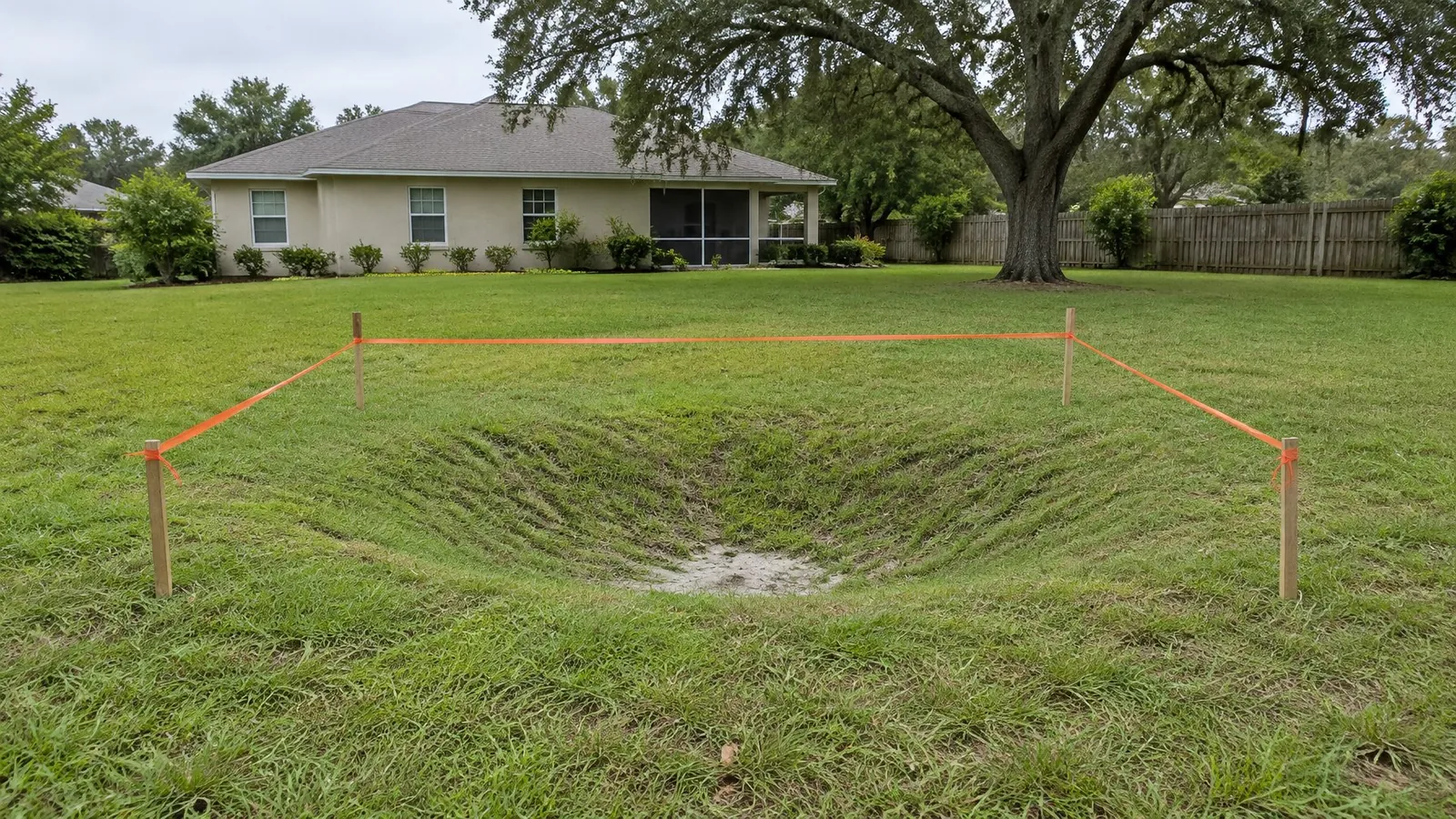
What a sinkhole is
Florida rests on limestone. Rain is slightly acidic, and over a very long time it dissolves openings in the rock. A sinkhole forms when the sand and clay above settle, wash or collapse into one of those openings. That is the Florida Geological Survey's definition.
How it happens depends on what lies over the rock, as the U.S. Geological Survey explains. Two kinds matter for houses:
| Kind | How it forms | What you would see |
|---|---|---|
| Cover-subsidence | Sand filters down into a void little by little. Typical where the cover is mostly sand. | A dip that deepens gradually, over months or years |
| Cover-collapse | A void grows under a clay layer that holds for a time and then gives way. | A hole that opens within hours |
Signs the state survey lists
The survey says that several signs together mean more than any single one. Every one of them also has ordinary explanations.
In the yard
Cracks in the soil. Ground that sags or slumps. Water pooling where it never did. A patch of grass or shrubs dying. Trees or fence posts starting to lean.
Around the house
Cracks in outside walls or the foundation. Paving that cracks or pulls apart. Broken water or sewer pipes. Water collecting along the foundation.
Indoors
Cracks in walls or floors. Floors that become uneven. Doors, windows and cabinet drawers that start to bind. Creaking or popping noises. Trim pulling away from the wall.
What looks like a sinkhole and is not
A broken water or sewer pipe, a failed septic tank, a rotted stump and buried debris all leave holes that look alarming. The survey calls them sinkhole imposters. Tell the professional assessing it about nearby pipes, septic tanks and any trees removed from that spot.
For a hole in the yard, keep children and pets away and ask the city or county which professional should assess it before anyone adds fill. Its size alone does not establish the cause. Do not use trash or yard waste to cover it.
Who looks into it
Emergency services, if anything is moving
911 brings fire rescue and, through them, your city or county emergency management office. The survey notes that local agencies may help with evacuating a home and assessing damage.
The road owner, if it is in a street
Call the city or county that maintains the road. On a private road it falls to the owners or the homeowners association.
A geologist or geotechnical engineer
No government agency inspects sinkholes on private land in Florida, the state survey says. The people trained to tell a sinkhole from other settling are licensed professional geologists and engineers, who test the soil with borings. Check a licence on the state licence search.
The Florida Geological Survey, for questions
Its sinkhole helpline is 850-245-2118. Staff can talk through what you are seeing. The survey also keeps a public map of reported incidents.
A foundation repair company
Once the cause is known, a repair company can discuss an appropriate repair plan. Where testing points to sinkhole activity, the repair is normally designed by the engineer and carried out by the company.
Insurance, briefly
Florida policies distinguish catastrophic ground cover collapse from other sinkhole damage. Read the definitions, exclusions and any endorsements in your own policy rather than assuming a crack or settling is covered.
Ask your insurance agent to explain the cover for your house. The companies reached through this site discuss foundation inspections and repairs; they do not handle insurance claims.
Some perspective
The process is old and mostly slow. The lakes that give Orlando its character are, for the most part, sinkholes that formed long ago and filled with water. The most widely known recent collapse, in Winter Park in May 1981, had come to look like any other lake about 14 years later, according to the U.S. Geological Survey.
Sinkhole questions
Can a foundation repair company tell me whether I have a sinkhole?
It can measure how the house has moved and may recommend soil testing. Deciding whether sinkhole activity is the cause is a job for a licensed professional geologist or a geotechnical engineer.
Is there a map that shows whether my street is at risk?
The Florida Geological Survey publishes reported incidents on a map and cautions that most were never verified by a geologist. The map shows where collapses have been reported. It cannot predict where the next one will be.
Ready to have the house looked at?
Only someone standing at the house can tell you what is going on under it. Call, explain what you have noticed, and ask for an inspection.
Describe the problem, book an inspection
Say where the cracks or dips are and when you first saw them. The independent local foundation repair company you reach can set a time to look at the house.
Call (407) 598-8829The call may be recorded. See how referrals are paid for and what happens to your details.